Warning
£16k–£38kest. / year
Unmanageable Workload (Burnout Risk)
Company-wide, workload is unmanageable.
High confidence

Pulsory asks your team how things are really going, anonymously, then shows you exactly what to improve, from culture and communication to the policies you might be missing. So you can act early, while problems are small and cheap to fix.
12 months free for founding customers · No card needed · Brochure in your inbox within minutes
The problem
Most business owners are the last to know when something's wrong. Not because people don't care, but because telling you is awkward, risky, or feels pointless.
“Nothing, honestly. It's fine.” Most people would sooner say that than tell the person who signs their payslip what's really wrong. It's not about trust, it's just hard to say out loud.
The useful stuff travels slowly. A team lead who needs more support than they're getting. A rota that's quietly grinding people down. By the time it reaches you, it's been softened, or it's already a resignation.
People are at their most honest on the way out, when saying it costs them nothing. What comes out is often something small. Something that was fixable months earlier, if anyone had known it was there.
What it costs
Losing someone doesn't arrive as a single bill. It's the advert, the interviews, the training, the shifts everyone else covers, the weeks before the new person is up to speed. It's spread across your year, which is exactly why it's so easy to miss.
What it actually costs you
Only 17% of organisations ever work out what staff turnover actually costs them.
CIPD Resourcing and Talent Planning Report, 2022
So it never shows up as a problem to fix. It just sits in your costs, quietly, year after year.
Work out your own number with the turnover cost calculator →
The answer
Pulsory sends your team a short, completely anonymous survey, then turns what they say into plain-English insights you can actually act on.
Because it's anonymous, and because it isn't coming from you, people tell the truth. And because it runs on a schedule, you hear about things while they're still small enough to fix cheaply.
You don't need an HR department, a data export, or a spreadsheet to get started. Add your team and it works from day one. Share your own figures later, like what training costs you and how long it takes, and the estimates get sharper still. Until then we use published UK benchmarks, so you always get a usable number.
I worked in the hospitality industry for over a decade. I was asked to fill in a survey maybe four or five times, and it felt more like an audit than a genuine attempt to resolve issues. That's why I built Pulsory.
Why Pulsory
Built for businesses that want to look after their people, without needing an HR department, a data team, or a big budget to do it.
Findings are written to help you fix things, not to tell you off. Even when a problem points at leadership, it's framed as what your team needs rather than what you got wrong.
No HR system to plug in, no data export, no consultant. Add your team and your first survey can go out the same day. Adding your own numbers later, like training costs and how long people take to get up to speed, sharpens the estimates. Leave them out and we use published UK benchmarks instead, so it's useful either way.
Every estimate uses your real training costs, how long people take to get up to speed, and the knock-on effect on the rest of the team. And if we can't work something out properly, we tell you, instead of inventing a figure.
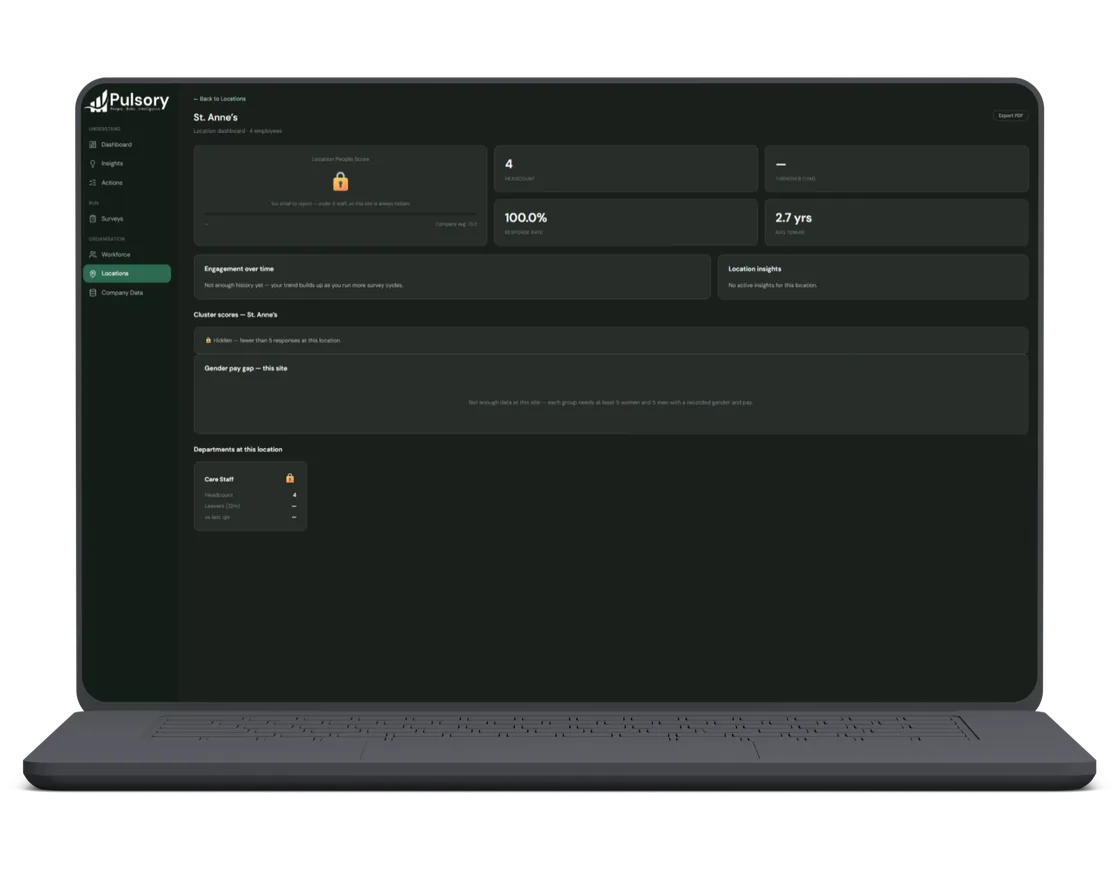
Answers are stored with nothing that could identify a person, and anything under five responses is hidden completely. Not “we promise not to look.” There's genuinely nothing to look at.
Next time they open a survey, the first thing they see is what happened because of the last one. That's the difference between people filling in a form and people believing it's worth their time.
How it works
Four steps from your team list to something you can actually act on.
Upload a list or add people one by one. No HR system to connect, nothing to configure.
Everyone gets their own private link by email, or a QR code to scan if they don't have a work email. Short questions, a few minutes, on any device.
When the survey closes, Pulsory looks across every team and site to work out what's really going on and what it's costing you.
Plain-English findings, what to do about them, and a task you can hand to someone to make sure it happens.
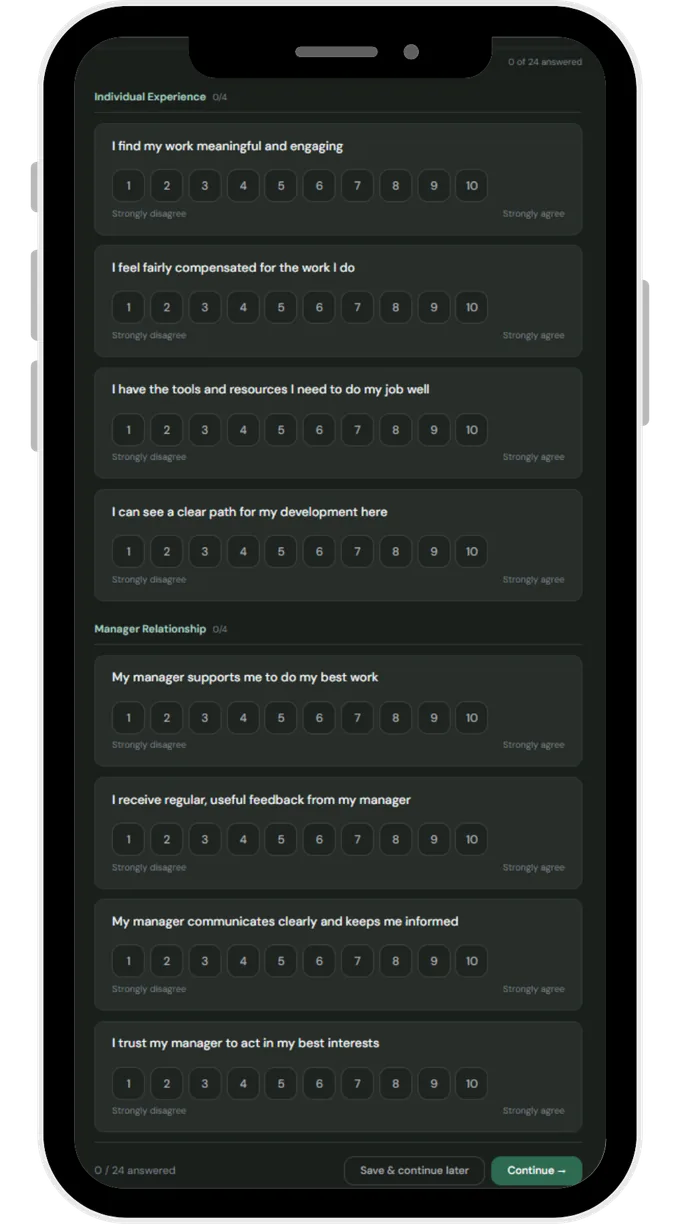
Every survey covers six areas: the day-to-day job · their manager · their team · the company · trust and fairness · wellbeing and future Plus any questions of your own.
What you get
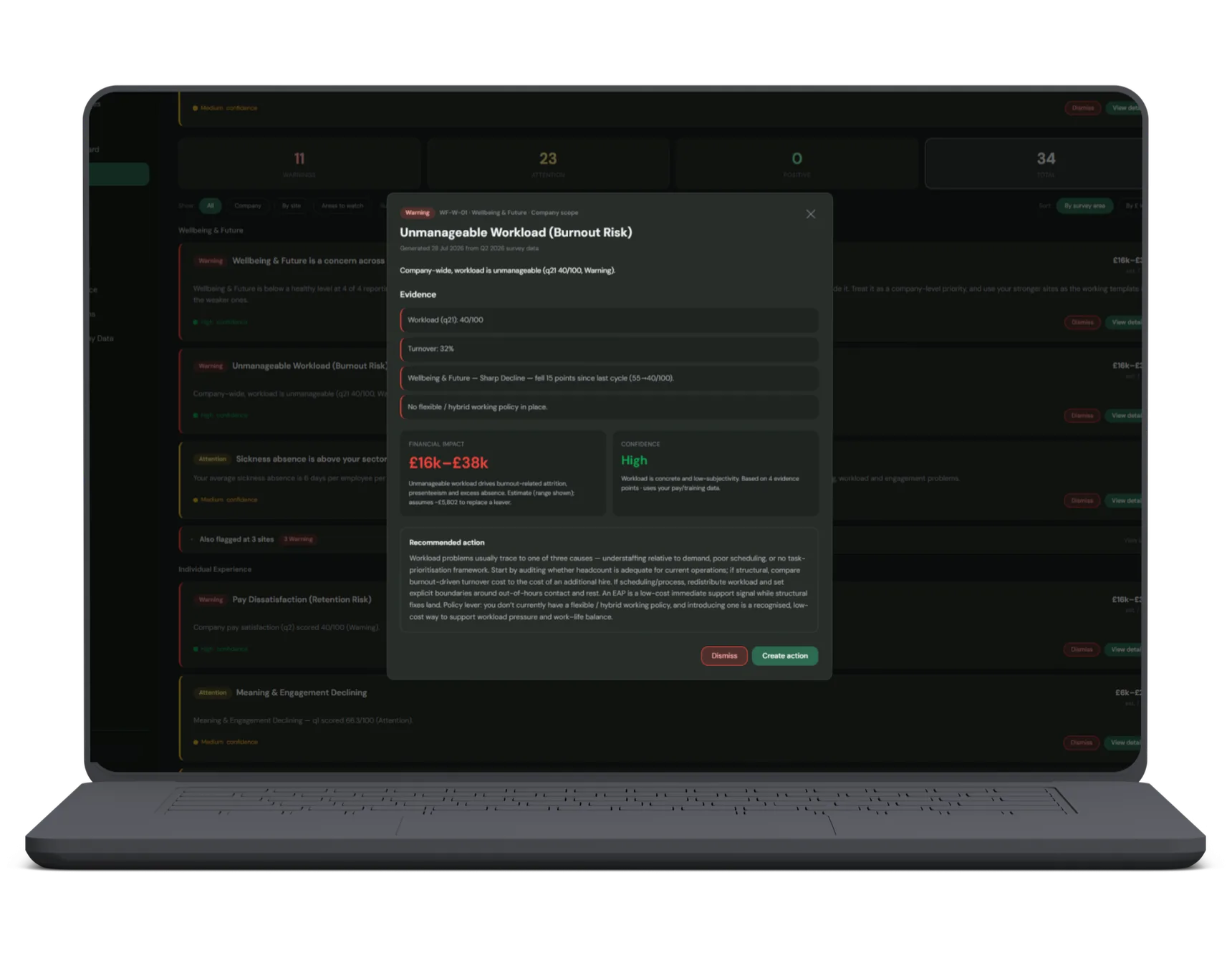
Each finding tells you what's happening, how sure we are, what it's likely costing you, and one clear thing to do about it. Open it up and you can see exactly how we got there.
Company-wide, workload is unmanageable.
High confidence
Below a healthy level at 4 of 4 sites. A systemic pattern rather than one bad site.
Medium confidence
Manager relationship is exceptional. Your most powerful, cost-effective retention tool.
Medium confidence
Example insights. Figures are illustrative.
Then what?
Knowing what's wrong is only useful if something happens next. So Pulsory helps you act on it, then tells you whether it worked.
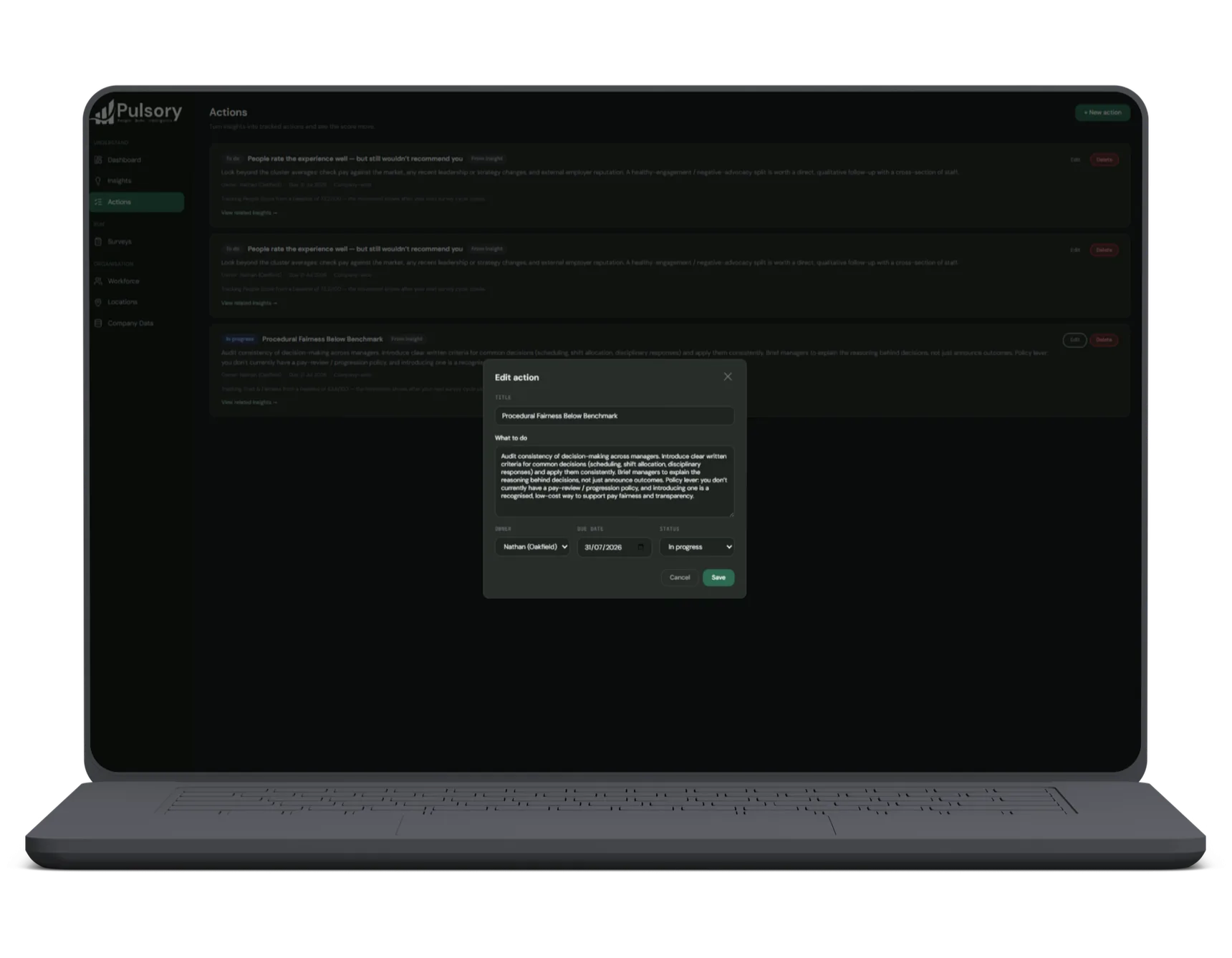
Create an action straight from any insight. Give it an owner and a due date, and Pulsory keeps track of it. No more findings that everyone nods at and nobody owns.
When you create the action, Pulsory saves where you were starting from. Next cycle it tells you what actually moved. “Trust in leadership up 11 points” is a very different conversation from “we tried something.”
Set goals for your People Score or any single area, then track them over time, with a clear view of what improved and what slipped since last cycle.
Next time they open a survey, the first thing they see is what happened because of the last one. That's the difference between another form to fill in and something people can see the point of.
And because they can see it working, they answer honestly again.
Only 12% of organisations collect data to check whether their retention efforts actually worked.
CIPD Resourcing and Talent Planning Report, 2022
Built for real teams
Multiple sites, staff without work emails, managers who each need their own view. None of that needs a workaround.
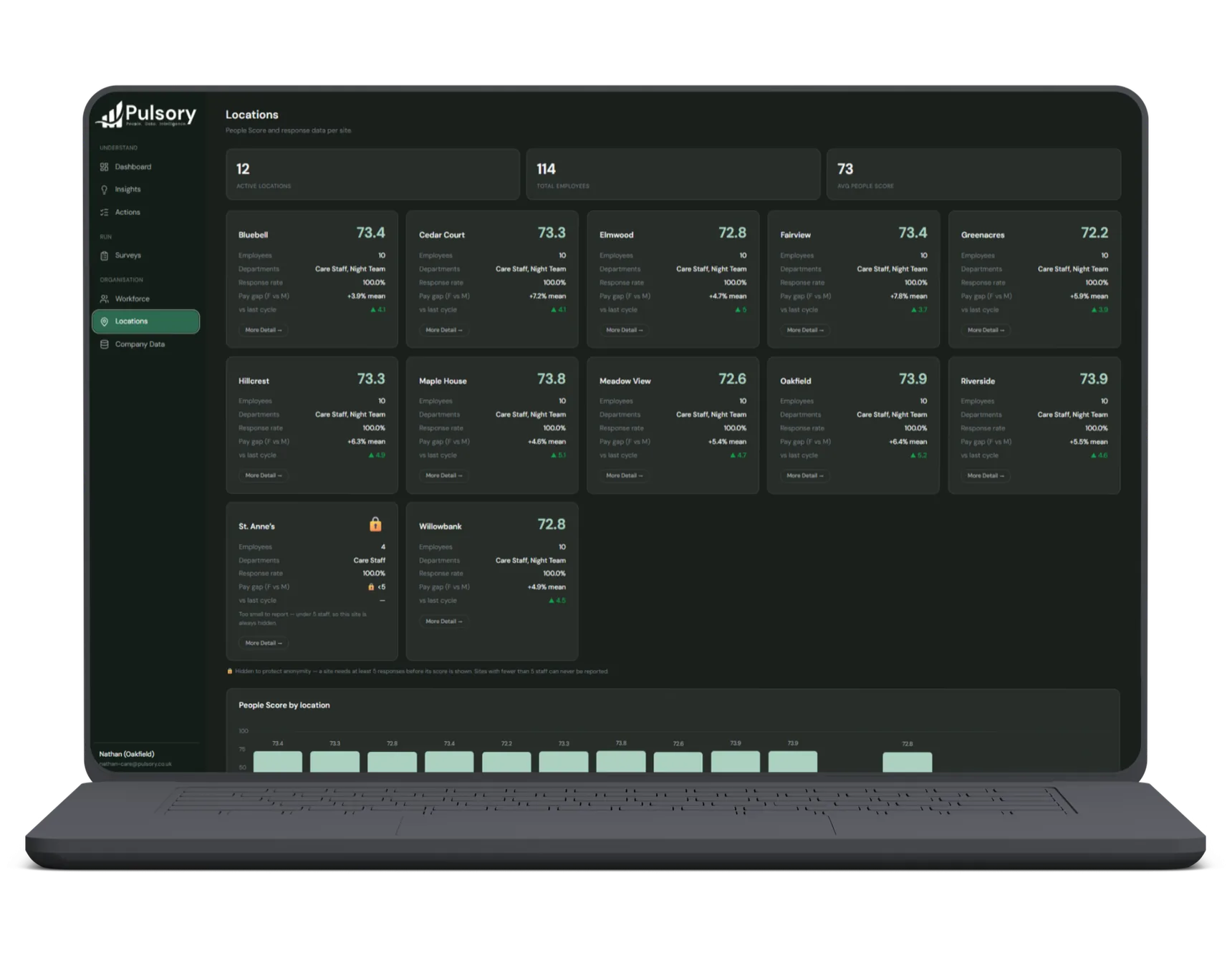
Run one location or twenty. See the whole business at a glance, drill into any single site, and compare them side by side.

Staff without a work email just scan a QR code to take the survey, ideal for kitchens, floors and shop floors.
Give area and site managers their own dashboard, scoped to just their people, with exactly the same anonymity protections. Managers never see their own scores.
Completely anonymous
Your team will only tell you the truth if they know it can't be traced back to them. So we built it so it can't be, then made sure you can see that for yourself.
Used once, to send each person their own private survey link.
Stored with nothing that could ever point back to a person.
Always combined, never individual, so no one can be singled out.
Encrypted in transit and at rest Google Cloud infrastructure UK GDPR aligned Never sold or shared
FAQ
The things people usually want to know before joining.
Founding customers
After that it's one price, set by how many people you employ, from £79 a month, or 15% less if you pay annually. Founding customers keep that price for as long as they stay.
Then from £79 a month. Every feature, unlimited sites, unlimited departments, at every size.
No card, no commitment, no surprise charges. See full pricing. Already a customer? Sign in here.
Join the waitlist and the brochure lands in your inbox a few minutes later.
Founding customers
Leave your details and the brochure lands in your inbox a few minutes later.
Pulsory hides any result with fewer than five responses, for every group including departments, so it works best from about ten employees.
I'll email you the brochure in the next few minutes.
Get in touch
Send a message and it comes straight to me.
Thanks for getting in touch. Your message has come straight to me.